
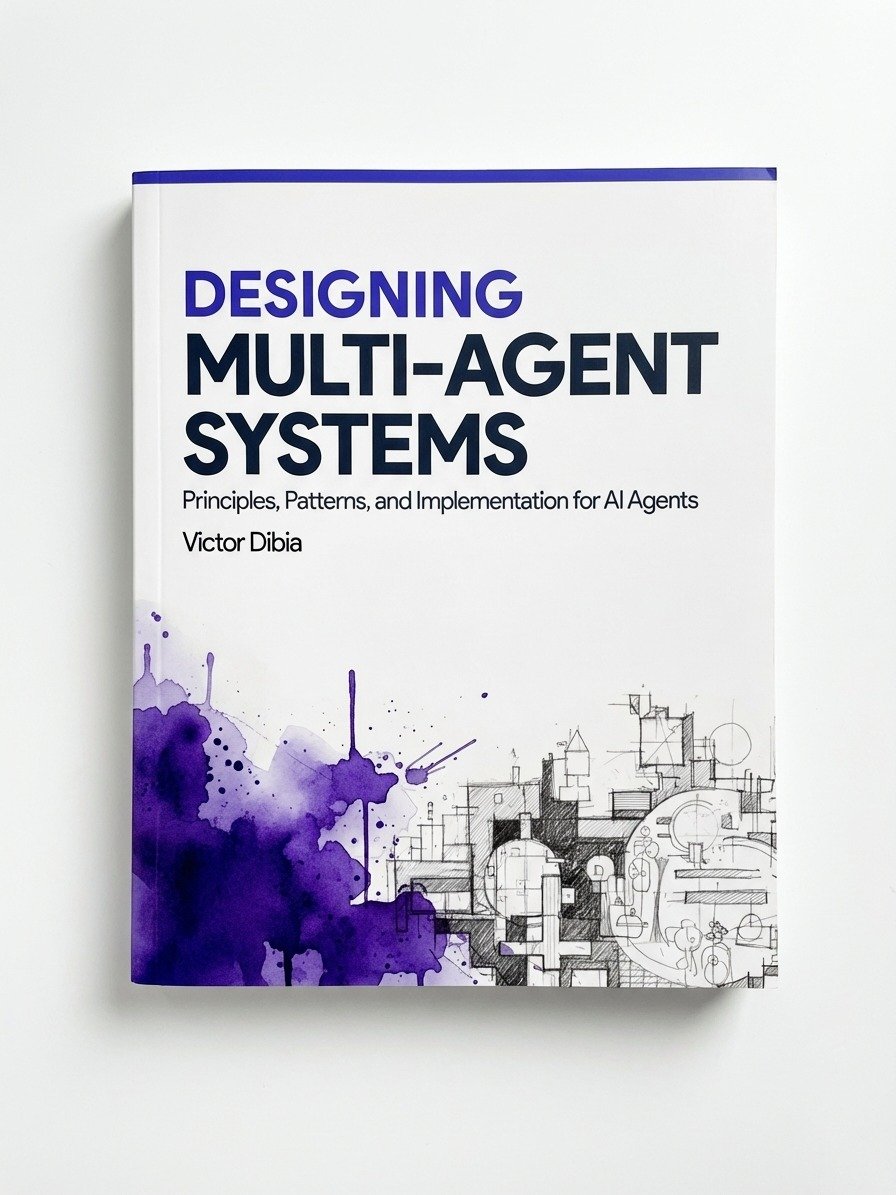

Designing Multi-Agent Systems Book
How to build applications where multiple AI agents reliably collaborate to solve new types of complex tasks.
In Designing Multi-Agent Systems, you'll take a first principles approach to learn to design and implement reliable, agentic applications from scratch, understand why their architectures work, and master patterns for collaboration, observability, interruptibility, and trust. These principles remain useful as the ecosystem evolves, giving you the tools to build scalable, robust, and human-centered agentic systems, whether in research or production.
Inside, you’ll explore:
- Multi-Agent Fundamentals — Core concepts and design patterns for multi-agent collaboration
- Build from Scratch — Step-by-step guidance for implementing agents, tools, as well as deterministic workflows and autonomous orchestration patterns.
- Evaluation & Reliability — Learn trajectory-based testing, structured outputs, observability, and performance metrics to ensure agents behave predictably.
- UX and Trust Principles — Apply human-centered design principles like interruptibility, capability discovery, and transparent decision-making to build agents users can rely on.
- Distributed Agent Protocols — Learn how protocols like MCP and A2A build enable distributed multi-agent systems that operate across networks, regions, and organizations.
Rather than teaching specific frameworks, this book gives you the mental models and first-principles reasoning through implementing a feature complete picoagents library with the same foundational concepts that power today's most capable multi-agent frameworks — from AutoGen and LangGraph to CrewAI and beyond. You'll come away able to design agentic systems that remain robust and useful as the ecosystem evolves.
Praise for the Book
"As a researcher at Microsoft who is close to the leading edge of Agentic capabilities, works with Microsoft customers on real world applications, and with the Autogen team on building the agent framework, Victor has a unique vantage point. He uses it to provide an exceptionally clear conceptual explanation of what agents can do, how to elicit complex behavior in real world applications by using multiple agents, and how to leverage multi agent frameworks. A truly excellent book!" — Valliappa Lakshmanan, Author of Generative AI Design Patterns (O'Reilly), CTO Obin.AI
"This book addresses a critical gap in the field—while many resources focus on tools and frameworks, few provide the principled foundation needed to make sound architectural decisions. His emphasis on building from scratch ensures readers truly understand the underlying mechanics and can make informed decisions about when and why to leverage existing frameworks. What sets this work apart is Victor's ability to bring structured thought leadership to one of the fastest-evolving domains in AI." — Andrew Reed, Senior AI Engineer, LangChain
About the Author
Victor Dibia is a Principal Research Software Engineer at Microsoft Research and Core AI. He is the creator of AutoGen Studio (a low-code interface for building multi-agent applications), core contributor and maintainer for AutoGen (a leading open-source multi-agent framework with 50k+ GitHub stars), and creator of LIDA (for automated data visualization). His work bridges AI research, system design, and practical implementation.